
Frequently Asked Questions
The PDGA is a nonprofit organization run by PDGA staff members, a volunteer Board of Directors, and thousands of volunteer hours from members to create all the programs . The PDGA uses the membership fees to:
- Organize and manage 10,000+ competitive events worldwide, and the PDGA supports each event with electronic resources;
- Manage player points, statistics, and rating system for 108,000+ active members;
- Support the annual PDGA Professional, Amateur, Masters, and Junior World Championships;
- Provide outstanding achievement awards to the PDGA Player of the Year, Tournament Director of the Year, Volunteer of the Year, and touring players;
- Produce an online disc golf course directory with over 11,000 entries;
- Fund the Marco Polo Program, which supports the introduction of disc golf into new countries by providing support and guidance as infrastructure is developed;
- Design and maintain the PDGA website where members can track their personal statistics in sanctioned events and get up-to-date information on tournament results, disc golf-related news, event coverage, and important announcements;
- Support development and maintenance of tournament and league organization and registration at DiscGolfScene.com;
- Facilitate event coverage of premier disc golf tournaments, including video coverage, hole-by-hole scoring, and more;
- Publish the Official Rules of Disc Golf and manage periodic revisions and updates;
- Manage the Competition Manual for Disc Golf Events, a companion to the rules of play;
- Organize and subsidize an insurance policy that is available to tournament directors for PDGA-sanctioned events in the USA and Canada;
- Provide sponsorship to Major, Elite Series which may include the form of a financial contribution, banners, flags, Marshals, and event registration/management assistance;
- Test and approve discs and baskets for sanctioned play;
- Examine other important aspects of disc golf from the environment to sustainability;
- Operate the International Disc Golf Center in Columbia County, Georgia, providing offices for the PDGA staff, the Disc Golf Hall of Fame, and The Ed Headrick Museum. This facility has three championship courses open to all disc golfers;
- Create and enforce standards for PDGA sanctioned events;
All of these PDGA activities and programs build credibility for disc golf and contribute to the formalization and growth of the sport. In short, as a PDGA member, you enjoy all the direct benefits of membership as listed above while also supporting and promoting the development of disc golf. The PDGA supports disc golf around the world and allows multiple opportunities for PDGA members to be active and engaged community members that help with the continuous growth of the sport of disc golf. Impact your local and international disc golf community by joining the Professional Association for all disc golfers.
If you ordered a member disc when joining or renewing your 2026 membership, your membership package will arrive within 3-4 weeks. You will receive an email with tracking information once your order has shipped. Thank you for your patience.
The Birdie, Ace and Eagle Clubs are premium membership upgrades that enable the PDGA to continue to strengthen our programs, grants, and activities globally including:
- Diversity and Outreach Grants
- Youth and Education Grants
- Throw Green Environmental Grants
- Competition Endowment Program
- Marco Polo Grant Program – an International Initiative
- Player and Course Rating Systems
- Marketing of the PDGA Majors
- Support for the PDGA Website and Media Initiatives
- Upkeep of our sport's permanent home, the International Disc Golf Center
All members of these clubs are listed on our website in a premium member list along with a designation on their player profile. If you would like to upgrade your membership and are current for the calendar year, please contact the Memberships Manager.
Absolutely! The PDGA is the Professional Association for ALL disc golfers.
Yes to both. We track all sanctioned PDGA event results for all members in our database. If, after renewing, you do not see an event added to your stats, please contact our Event Support Team. Please be sure to include a link to any event in question.
Currently, we do not offer prorated memberships. If you feel you are going to compete in several PDGA sanctioned events before October 1st, then it will be worth it to go ahead and join. When you join the PDGA, any required temporary membership fees at PDGA sanctioned events are waived. However, if you will not be competing much before then, join after October 1st and your membership will be extended through the following year.
Yes. Contact the Membership Manager and we will be happy to make the upgrade for you.
Yes, please contact the Event Support Team so that they can assist you. Please include a link to any official results pages, as well as your PDGA number.
If you have an account here on PDGA.com, you can update your own member information any time you like. First, login and select the "Edit" tab under "My Account". If you see phone number and mailing address fields, just update your information, hit the Save button and you're done. If you don't see those fields, we'll need to link your PDGA membership with your PDGA.com user account. Send us a message including your PDGA number and your username and we'll take care of it ASAP.
A full list of member benefits can be found here.
You can find your PDGA number using the Player Search located under the Membership link in the main menu or by going directly to pdga.com/players.
Recipients of international shipments may be subject to import taxes, fees, and customs duties, levied by the customs office of your shipping destination. These fees are based on the customs regulations of the destination country. Customs policies vary widely, and some countries don't charge import fees or custom duties for shipments that fall below a minimum value which most basic international membership packages don't exceed. Please contact the customs office of your country for more information.
PDGA memberships are non-refundable and non-transferable. PDGA membership benefits and services are available to you immediately upon completing the registration process.
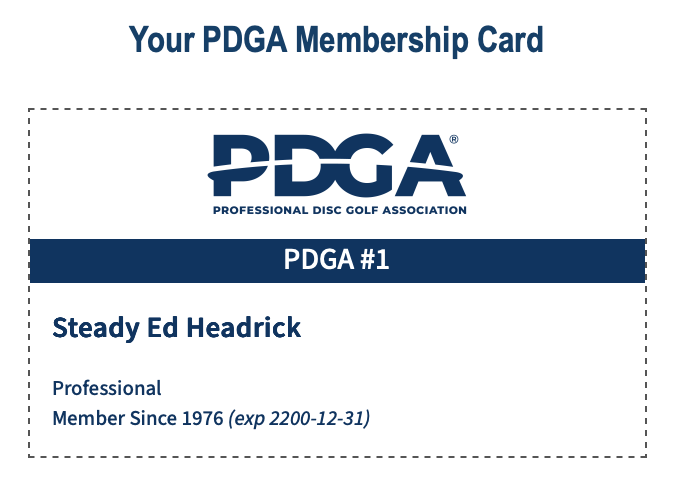
On your player profile while you are logged in, you will find a button at the top of your profile "Member Card". Click this to get a printer-friendly version of your membership card.

2026 member / premium membership discs
(Available starting October 1, 2025)
 Membership Disc
 Birdie Disc
 Ace Disc
New in 2026: The Birdie disc is now also included with your Ace Club membership.
Disclaimer: Please note the above images are digital proofs. Actual discs may vary slightly in color and details due to the production process.
It will say pending until the fulfillment office downloads the order. Your membership package will begin shipping in November 2025. You will receive an email with tracking information once your order has shipped. Thank you for your patience.
Ratings updates occur on the second Tuesday of each month. The online event report submission deadline is the Sunday prior to the ratings publication date.
| Report Submission Deadline | Ratings Publication Date |
|---|---|
| November 09, 2025 | November 11, 2025 |
| December 07, 2025 | December 09, 2025 |
| January 11, 2026 | January 13, 2026 |
| February 08, 2026 | February 10, 2026 |
| March 08, 2026 | March 10, 2026 |
| April 12, 2026 | April 14, 2026 |
| May 10, 2026 | May 12, 2026 |
Your PDGA Player Rating is a number that shows how well you have played in PDGA competitions in the past year in comparison to the Scratch Scoring Average (SSA) of the course layouts you played. Players who average the course layout SSA will have a rating of 1000. As of 2021, top pro players who average scores lower than SSA have ratings over 1000 ranging up to 1050. PDGA amateur men average around 860 and women around 725. Each additional throw in your score will reduce your rating from 7 to 13 rating points depending on the SSA of the course.
Players who enter a PDGA event in a division tracked by the PDGA will automatically get their results entered into the ratings system. A new member will receive a Preliminary Rating as soon as they play an event when the TD posts Unofficial Results.
All rated rounds you have played and have been reported to the PDGA within 12 months of your most recently rated round will be included in the calculation. However, if any one of those ratings is either more than 100 points below your average rating or more than 2.5 standard deviations below your rating – whichever number is smaller – that round will not be included. That works out to about 1 in 50 rounds getting dropped. Rounds where you DNF (Do Not Finish) are never counted in your rating. The most recent 25% of your rounds get double weighted which slightly boosts your rating if you have been steadily improving. If a player has fewer than 8 rounds in the last 12 months since their most recent round, then we’ll go back up to another 12 months until we find up to 8 rounds but never go back any farther than a total of 24 months.
Check how many rounds were included in your current player rating calculation on your “Ratings History” tab. You probably had older rounds drop off from your current player rating calculation.
If you have at least nine rounds, the last 25% of rounds are double-weighted. Did you include that in your calculation?
You can get the most up-to-date information about the ratings system in the PDGA Ratings System guide.
Your first rating can be calculated after just one valid round of tournament play. It will be posted on the PDGA website the next time the ratings are updated.
Your current PDGA player rating and stats can be found on your PDGA Player Profile. You can search for your player profile by selecting Player Search from within the Membership menu.
All amateurs with the exception of aged based divisions, like Juniors or Masters and older, compete in divisions based on rating levels. You may not play in a lower division if your rating is above a certain number. The ratings breaks for each division is shown on page 5 of the PDGA Tour Standards. In addition, there are ratings events where everyone – Ams and Pros – play in a division based on their rating.
If you have pre-registered, the TD may allow you to remain in that division as long as the event is within two weeks of the ratings posting date. If you did not pre-register before the new ratings were posted, then you are expected to play in the division (or higher) where your new rating now resides. This only applies to Amateur players registered for amateur ratings-based divisions; it does not apply to a Professional-class player taking advantage of the Pros Playing in Amateur Divisions program.
Tournament Directors may upload tournament scores using the PDGA Tournament Manager web app. Preliminary unofficial ratings will be calculated for each round (click on the Show Ratings link). The results of the event at this stage are considered "Unofficial Results". When the PDGA receives the official tournament report from the tournament director, course layout assignments are verified, points are calculated, and scores are certified as official.
If you don’t see any scores or unofficial ratings during or just after the event, it’s because the Tournament Director has not uploaded the scores.
Your rating is only updated when an event director has submitted an official event report for an event you played in by the deadline before each update is posted. If you haven't played in any new events or in those that have been reported to the PDGA, your update date and rating will remain unchanged. League rounds are not counted until the entire league has been completed and the report submitted.
Either an event you played quite a while ago just got reported for this update or it’s possible an older event you entered needed to be corrected when a scoring or course layout assignment mistake was reported or discovered.
If you are looking at Unofficial Results or ratings, contact the TD about making corrections. The PDGA office cannot help you since they do not have the tournament report from the TD yet. If you are looking at Official Results and see a problem, send email to [email protected] and include a link to the event.
Propagators are players with a rating above 699 and based on at least 8 rated rounds, and whose rating effective date is within a year of the start date of the tournament. Their scores each round are used to determine the course rating (SSA) and subsequent unofficial ratings for each player that round. It takes at least two propagators playing a specific course layout for the online software to calculate unofficial ratings for a round. Propagators are shown on the tournament pages with their rating in bold type.
The unofficial ratings for each round are calculated from only the scores the propagators threw that round. Their scores will naturally vary from round to round even when it looks like the weather conditions are similar either on the same day or even the next week with a completely different set of propagators. The typical variance in a round rating for the same score under similar conditions can range up to 25 rating points (about 5%).
Yes, it can sometimes be true by a few percentage points. However, here's the catch. It's not because these top players have higher ratings. A couple factors are in play. There can be additional tournament pressure in higher tier events especially when local players are grouped with traveling pros.
Yes. The weather and tournament pressure are automatically taken into account resulting from the typically higher scores propagators shoot in tougher conditions. These higher scores thrown by propagators will produce higher ratings for the same score on the same course layout compared with rounds played in milder conditions and recreational play.
Sometimes. Once the tournament scores and report are submitted to the PDGA, a preliminary SSA is calculated for each round. Then, the software compares these preliminary SSAs. If these two SSAs are statistically far enough apart, each round will get separate official ratings because the software identified a statistical difference in playing conditions between rounds. However, in most events these preliminary SSAs are close enough that they will be combined to produce a single official SSA so everyone gets the same rating for the same score in both rounds.
Sometimes. The official ratings (not unofficial) can end up different for the same score thrown early versus later in the day when weather changes significantly. This special process to calculate ratings by time segments over the day is done when the TD or another official notifies the PDGA that certain rounds had significant weather differences, especially wind. The ratings team will either break up the scoring data for those rounds by time segments within a single large division (more than 80 players) or by grouping smaller division(s) who played near the same time of day.
This is true in some cases. The roughly 2%-7% difference (1-3 throws) seems to be due to a little more pressure on players when playing tournaments versus leagues. Presuming the weather conditions are similar, it appears to be the most likely factor to account for the difference. The good news is that this effect doesn't help or hurt the ratings of players overall. No matter how difficult or easy a course plays, the average player rating of the propagators before the round is about equal to the average of the ratings they receive in each round. Check it out and see.
If you do not complete a round for any reason other than manipulating your rating, and if you inform the TD that you will not be completing the round, you will receive a score of 999 indicating you Did Not Finish (DNF) that round. You will not get a rating for that round but will receive ratings for any other rounds you completed before and sometimes after that round (if TD allows). If you complete a round, you will receive a rating for the round, regardless of whether you were sick, injured, or otherwise impaired. So keep that in mind when deciding whether to complete the round.
This is a Class D4 offense under the PDGA Disciplinary Policy & Process with penalties according to Competition Manual 5.06.C.
When reported by the group to the TD, the offending player will receive an 888 DNF for trying to manipulate their rating. This is a Class D4 offense under the PDGA Disciplinary Policy & Process with penalties according to Competition Manual 5.06.C.
All rated rounds you have played and have been reported to the PDGA within 12 months of your most recently rated round will be Included in your rating calculation. However, if any one of those ratings is either more than 100 points below your average rating or more than 2.5 standard deviations below your rating – whichever number is smaller – that round will not be included in your current rating update and indicated with a No.
At least 13 holes must be played by the field to produce an official round rating. For courses with less than 13 holes, scores from two rounds can be combined to produce an official round rating. Official ratings can be produced for rounds up to 36 holes long. The number of holes in each round is weighted to determine a player's PDGA rating.
Every throw equals about 10 rating points on a typical 18-hole course from the long tees. If your scores average 10 throws over SSA, your rating will be 100 points lower than 1000 which would be 900. So a player with rating of 950, who is about 5 throws better than a player with a 900 rating, should probably spot the 900 rated player about 4 to 5 throws if they are trying to level the playing field for the round.
In theory, yes, but it has a very low probability of happening. We know that a propagator will throw more than three shots better than their rating about 1 in 6 rounds. We calculate ratings based on at least 2 propagators. And normally, we have more than 20 in most events. But let's say we just have 5. The odds that all 5 propagators will shoot more than 3 shots better than their rating in a round is 1 in 7776 rounds (1/6 to the 5th power).
Dealing with ‘sandbagging’ – players entering a division below their skill level – used to be a challenge. Since 2002, PDGA Player Ratings have been used to group amateur players in competition divisions to prevent players from entering divisions below their rating. In addition, ratings provide one element for ranking the world's top players on the PDGA Tour. Course ratings pave the way for statistical comparisons of courses around the world with the potential to help improve their designs and levels of challenge.
How would you calculate a fixed rating for a course layout simply by taking measurements, looking at foliage, fairway widths and accounting for hazards? It’s also common for TDs to add temp holes, change tee or pin positions, or use new permanent or temporary courses such that no course rating would be on file to use for that layout. Then, imagine trying to calculate and keep track of those layout ratings on courses with dual tees and 2 or more pin placements per hole that can produce thousands of configurations.
Once the Touring Pros for a given year are calculated they are sent an email with information on how to take the Official's Exam free of charge. If you didn't receive this email please contact the PDGA Office.
The Certified Official's Exam can be found at www.pdga.com/rules/exam
The test is not timed, and is open book. The subject matter will cover both the Official Rules of Disc Golf and the Competition Manual for Disc Golf Events.
You may take the exam an unlimited number of times until an acceptable score of 80% is achieved.
The PDGA Rules Official certification is good for three years, unless otherwise noted by the PDGA Board of Directors due to a major rules revision.
There is a US$10 fee for all persons required to take the PDGA Certified Officials Exam.
Tournament Directors and Assistant Tournament Directors of PDGA-sanctioned events are required to be Certified Officials. Additionally, all competitors in Elite Series or PDGA Major events must be Certified Officials in order to register for and play in those events.
Send an email including your name and PDGA number to our TD Training staff and someone will get back to you.
Register for training by filling out the TD Training Registration form. You will receive an invitation email to register onto the PDGA TD Training platform.
You can go back and review the slides as many times as you need to understand the correct answers and re-take the quiz.
You must get a score of 70% or higher on the quiz for the hole to count as completed.
This course is designed for all PDGA Tournament Directors. While it might be more of a review for the most experienced TDs, we believe everyone that completes the training will benefit from the time they spend on it. For new TDs, this will provide you with many resources, tips and tricks for making your events run as successfully as possible.
You will receive a certificate that shows your successful completion of the course, and your information will be stored in the PDGA database of TDs with the TD Training Certification.
At this time, the training is not required, but we encourage both experienced and new TDs to participate in it, as we think it will make your job a lot easier running disc golf tournaments in the future.
Simply close out of the course and when you log back in, you choose the hole you want from the course map and click the “Resume” button. Don’t feel pressured to complete it all in one session.
TD Training is an online interactive learning experience utilizing videos, interactive graphics, exercises, and a narrator to walk you through the training and quizzes that cover nearly every aspect of running a sanctioned event. TD School is a collection of videos on various aspects of being a TD that are also included within TD Training.
The PDGA Support & Training Team developed the TD Training course along with EI Design, an online training development company.
TD Training is free and available to all PDGA members.
Yes! But currently the training is only offered in English, and the training is based on the standard ORDG and Competition Manual, so be advised that certain rule and practice variations may exist outside the United States and Canada. Those can be found in Section 6 of the Competition Manual.
No, this is an engaging and interactive training program set up to provide any information PDGA staff thought would be helpful for your journey as a TD. The training comes with videos, interactive graphics, a narrator to walk you through the training, and quizzes at the end of each hole.
That can vary, each lesson takes a different amount of time. While the overall training can take 10+ hours to complete, don’t feel like you must do it all in one sitting. The training is designed to fit into the schedules of our busy TDs, allowing them to pick up where they left off.
The PDGA’s TD Training course consists of 18 lessons (or “Holes”) that cover topics from determining what type of event to run, planning your event, sanctioning your event, setting up registration, use of PDGA’s tournament management software, using PDGA Live scoring, event finances, rules and rulings, and submitting your event report.
PDGA’s TD Training program is a web-based course designed to teach prospective and existing Tournament Directors both the technical aspects and “Best Practices” on how to run disc golf tournaments.
LED lights and ribbons may be used in some conditions when authorized by the Director. Please see section 813.01 in the rule book for the complete rule.
Yes. It can be found here: http://www.pdga.com/rules/3-4-dress-code
Refer to the PDGA Tour Event Levels & Tiers page for a description of PDGA events and different tier levels. If you have further questions, please contact our Event Support Team.
To become a PDGA Certified Rules Official, take the online exam at www.pdga.com/rules/exam
On the top menu bar click on "Events". There will be a drop-down option stating "Tournament Directors"; click on this and look on the far right-hand column to find "TD Payment". QUICK LINK: http://www.pdga.com/tdpayment
Under the top menu bar you will see "EVENTS". There will be a drop down menu; click on "Tournament Directors". The forms will be listed in the column on the right-hand side of the page listed as "Documents and Resources". QUICK LINK: http://www.pdga.com/tdinfo/resources
Yes and No. You may still compete in amateur divisions at A, B, and C Tier events if your player rating falls within the PROS PLAYING AM guidelines here: https://www.pdga.com/pdga-documents/tour-documents/divisions-ratings-and-points-factors. However, you are now classified as a Professional with the PDGA and are ineligible to compete in Amateur Majors such as the US Amateur Disc Golf Championship and Am Worlds.
If you login to PDGA.com (not Tournament Manager) and go to your event page from the tour schedule, you should see an "Edit" tab. That tab allows you to view/edit your Tournament Manager event password as well as edit your event name (should you add a title sponsor, etc.). If you are unable to login to PDGA.com, you can send an email to [email protected] and we will resend your confirmation email that includes your Tournament Manager password.
If you have carefully checked the list (some courses are listed under a park name as opposed to the locally-used course name) and the course is not listed, it is not an existing entry within the PDGA Course Directory. Please see instructions for adding a course at https://www.pdga.com/help/course-directory to add the course to the PDGA Course Directory.
You may use the <Temporary Course> item instead, but should explore having the course added to the PDGA Course Directory for future use.
You may only deduct player pack cost/value from Amateur divisions as the total Amateur purse is made up of both player packs value and the value of prizes awarded based on place of finish. The Pro purse is ONLY comprised of the cash awarded based on place of finish. If you wish to provide a player pack to Pros you may do so, but you need to pay for it in a way other than removing that value from the Pro cash purse.
Within Tournament Manager, click on the "Setup" menu item and then under the "Hole Scoring" section insert a different code for your live scorers and click the "Update Access Code" button. Using that code, your scorers will then only have access to live scoring.
Right, you only want to use a 999 or 888 code for a player that didn't complete (or start) a round that they were scheduled to play. In this case, simply leave the scores blank for the rounds those divisions did not play.
When accessing your scorecard, after entering in the access code, your player's name, and after clicking “Keep score Round X”, there is the option to select “Scores only” or “Throw Stats”. Tap on “Scores only” to toggle it to “Throw Stats” (or vice versa). Whichever you select will carry over to your next round, unless you toggle it back.
Quick mode allows you to enter your Throw Stats at the end of a hole, Live mode allows you to enter your Throw Stats as the hole is played.
No, this step can always be skipped, except for when the shot ends in the Basket. All shots that complete the hole must have a distance added in.
To delete a throw, hit the minus button (-). To edit a throw, tap the throw icons, then the pencil button next to the throw you’d like to edit.
To switch modes, tap the menu button (≡), then settings. From here, you can change modes, as well as change other Digital Scorecard settings.
To change between Throw Stats and Scores only, tap on a player’s name on the scorecard. This will allow you to toggle between the two scoring modes.
Yes. Please visit our help document for more information.
The Throw Stats summary can only currently be viewed on the desktop version of the website but will be added into the mobile version soon.
Stats cannot be edited after the round. If you would like the entirety of your stats for a round hidden, contact [email protected]
This feature is not yet available but will be in the future.
Throw Stats are preserved, and in the future players will be able to view the entirety of their stats over time.
- Career wins consist of individual wins in any Amateur or Pro division of a stroke-play tournament. Doubles, PDGA League, and other formats are not included in this total.
- Career earnings are only displayed for players who are classified as Professional. This includes any Pro who has been reclassified as an Am.
If you know of a course that is not listed in the directory, you can add it quiclkly and easily. To add a new a disc golf course to the PDGA Disc Golf Course Directory, you'll need a user account on PDGA.com. If you already have an account, login now. If you don't, create a free account.
Please see the PDGA Disc Golf Course Directory Help page for details on how to add a new course.
If you know that a course has been changed, or if you know something about a course in the directory is incorrect, you can make quiclkly and easily make the necessary edits. To edit a disc golf course in the PDGA Disc Golf Course Directory, you'll need a user account on PDGA.com. If you already have an account, login now. If you don't, create a free account. Once you're logged in go to the course information page and click the "Edit" tab.
Use the PDGA Disc Golf Course Search and select a Country from the drop-down list. You can search by City, State/Province, or Postal Code and the results will return all courses in the directory in order of proximity to your search parameters.
Yes. They can be acceptable for the lowest tier competitions. Ideally, the PDGA would prefer that those who produce homemade baskets submit a sample and get them PDGA approved as long as the basket doesn’t violate any current patents. The submission process is here.
Yes. However, it’s imperative that a professional designer be involved for the design phase so the course is not only suitable for those who will play it but also as safe as possible. A contact list of designers who can help find someone to help if they themselves aren’t able to help directly is available here. Typically, Eagle scouts have been doing something to improve an existing course versus building a course.
Much depends on whether holes are mostly in the open or in the woods. Wooded holes have much higher upfront costs for clearing, depending on who does the work. However, maintenance can be minimal other than occasionally trimming some new growth limbs and possibly spreading wood chips on the fairways every few years. Open holes require some level of regular grass mowing but every 2-3 weeks may be fine. Hard surface tees may need to have dirt or gravel added in front of the tees every year or two to deal with wear.
We’ll assume the land is available already, but that’s an additional major expense if it’s not. A barebones installation with light duty baskets, natural tees and simple wooden signs and do-it-yourself design (not recommended) can be installed for about $350 per hole. A full service community course with a heavy duty basket, dual cement tee pads, nice dual tee signs and two sleeves for basket placements on each hole could run up to $1000 per hole which includes a basic design fee on a property with little clearing to be done.
The chart that can help estimate acreage is available here. The very shortest beginner courses may need only half an acre per hole on average. The more wooded the property, the less space is needed because the woods can provide a safe buffer between fairways. Championship courses might need more than one acre per hole but again that can vary based on the amount of woods involved.
The initial steps are the same as getting a course approved for a public park. The Course Development area on this website has many documents to help with approving, designing and installing a new course. Check the Disc Golf Course Designers group to see if any members are located in your area. They can help you through all steps of the process.
The Course area on this website has many documents to help with approving, designing and installing a new course and is located here. Check the Disc Golf Course Designers group to see if any members are located in your area. They can help you through all steps of the process. If there’s no one on that list nearby, do a search of courses near your zip code and contact some of the people listed as contacts for those courses, especially courses in public parks.
If you are not planning on making up the week, you can simply leave this week's scores empty. Don't record any scores, and the round will simply be blank on the event results page.
If you wish to extend your league by a week and make up the missed week, contact the Event Support Team immediately after the missed week and request the league be extended.
Contact the Event Support Team to remove the partial round hole scores.
No. All players participating during league must be reported, players can not opt out of reporting or ratings in any PDGA sanctioned event, including leagues.
Since not all players will play each week of a league, the total score across all weeks can’t be used to do rankings, so ranking is instead done by total points earned within each division of the league. Points are awarded based on how many players a competitor either ties (including themselves) or beats within their division during EACH week of play times the points factor for that division.
Not really. PDGA Ratings are calculated using what's called a zero sum process. The total ratings points earned in a round by the group of players with established ratings (who generate the ratings) will always total the same as the total of their player ratings going into the event.
PDGA rules must be followed in leagues just as they are in regular tournament play. The one exception allowed for league play is players of legal age may drink during rounds if the park rules allow alcohol to be consumed on the course. However, please drink in moderation since courtesy rules can be enforced to penalize unruly behavior.
If the same league plays more than one day in a week, a separate sanctioning form must be submitted for each week day. For example, if you have a league that meets every Tuesday and Thursday, the PDGA would see that as a Tuesday league and a separate Thursday league for reporting purposes. That doesn't mean the league couldn't continue to locally process their league standings, results and payouts with those days combined.
You may offer either one or two layouts on a specific league day. The league can change each week so the same layouts or courses are never played twice, or can stay at the same course and layout every league day.
The TD determines the basic entry fee per day for each league division. The TD adds $1 fee to each of those entry fees which is paid by each player whether PDGA member or not. From that $1 fee, $0.50 goes to the PDGA and $0.50 goes to the TD to help with their league expenses, compensation and possibly final league prizes. The fee to sanction as a PDGA league is $25.
There's no temporary membership fee to play in a PDGA league. However, non-members will not receive ratings they can see online nor earn PDGA points.
Yes. Players will earn PDGA points based on how many players they tied or beat in their division during each week of play. League points are 1/2 the amount of points of a C-Tier tournament.
Points are counted toward the year of the last week of the league. For example, if a league runs from December 2024 to January 2025, all of the points earned from the entire league will count toward your 2025 points total.
Yes. Some TDs may either want to or be required to sanction their league for the PDGA insurance coverage. It takes at least 3 propagators to produce unofficial ratings each week. However, even if your league has fewer than 3 propagators some or most weeks, the PDGA will use an alternate method to generate official ratings for the current and hopefully new PDGA members in your league once your final league results are submitted.
Yes. Current PDGA members will earn ratings and even non-members will earn them even though they won't be able to see their official ratings until they join or renew. Players will see unofficial round ratings each week when the league director posts the scores online just like regular tournaments.
TDs can run their leagues pretty much however they run them now using best average scores, a points system, best 4 of 10 finish positions or handicaps to determine nightly and final league standings. Payouts will not be reported to the PDGA so amateurs may even get cash payouts if the TD prefers and they will not lose their amateur standing.
Simply sanction multiple league sessions to cover the full length of your league. For example, if your league runs 18 weeks, just sanction two 9-week league sessions to cover it. The main reason for the 10-week limit is so scores get reported to the PDGA within 3 months of the time a league session starts so players can get official ratings for their league rounds without waiting half a year.
PDGA league sessions include 6 to 10 weeks of singles play. No doubles yet. Players enter standard PDGA divisions or the league can be run where everyone participates in one handicap division as long as the TD reports players' raw scores to the PDGA site within standard PDGA divisions so players can earn ratings. The League Director (and Assistant Director, if you choose to have one) must be a PDGA Certified Official and they are allowed to play.
 Online Registration
 Registration List
 Unofficial Results
 Official Results
An account on PDGA.com allows PDGA members to link to their PDGA membership so they can manage their contact information online and upload a photo for display on their player statistics page. It is also required is for anyone that wants to add, modify, or review a disc golf course in the PDGA Disc Golf Course Directory or comment on a story.
If you don't have an account, or the system doesn't recognize your email address, you can create a new account at www.pdga.com/user/register.
Your PDGA membership might not be linked to an account on PDGA.com. If you don't have an account, or the system doesn't recognize your email address, you can create a new account at www.pdga.com/user/register.
If you have signed up for an account on PDGA.com, and cannot remember your password or username, follow these steps:
- Go to www.pdga.com/user/password and enter your username or email address.
- Find the email with the subject line "Replacement login information..." in your email inbox.
- Click once on the link in the email to open the "Reset password" page in your web browser.
- Enter a new password that you can remember in the “New password” field.
- Enter that same password again in the "Confirm new password" field.
- Click once on the Log In button.
Yes. If there are no local tournaments, you might consider sanctioning and running your own WGE tournament. You will need to complete a sanctioning agreement and meet all sanctioning requirements (current membership, certified official, fee payment) and all WGE tournament requirements (three propagators playing on the same layout for both rounds, upload scores, submission of TD Report. etc.).
Check out the PDGA Tour Event Planning & Management resources for more information on running a tournament.
We recommend that you pre-register for your local WGE as soon as possible to help the Tournament Director prepare for the event and to secure your player pack (if offered). Each local WGE has its own process and day-of registration may NOT be available, so please check with your local WGE Tournament Director for more info.
The WGE Players’ Packs will be made available for WGE Tournament Directors to purchase. Check with your local WGE TD to confirm whether this players’ pack will be offered at your event. There will be a registration deadline determined by your local WGE TD for receipt of the players’ pack. If your local WGE TD is not offering the WGE Players’ Pack, you can purchase one at the PDGA Store [update link once built out]. While supplies last, the WGE Players’ Pack is available to everyone on PDGAStore.com.
Scores will automatically be updated on the overall WGE results page. The deadline for Tournament Directors to submit the scores is August 8, 2022. PDGA Women's Global Event winners will be announced on August 15, 2022 in an article featured on the front page of PDGA.com and throughout the WGE social media pages.
For all divisions except Junior divisions 12 and under (FJ12, FJ10, FJ08, FJ06), the scores from the first two rounds of each participating tournament will be submitted by the individual Tournament Directors and rated by the PDGA. These round ratings will be totaled and averaged to determine a player's "Global Score." For the rounds to qualify, the event must include two rounds and have at least three ratings propagators playing on each layout during each round.
For Junior divisions 12 and under, the score of the first round of the event will be submitted by the Tournament Director and rated by the PDGA. Note that the layout played by Juniors under 12 must have at least three propagators playing that same layout to get an accurate rating for the PDGA Women's Global Event.
For tournaments without sufficient propagators in women's divisions, up to five male propagators may play the same layout to ensure accurate ratings without incurring PDGA post-event fees. These propagators should play in Mixed divisions for which they qualify.
The division you play at a WGE event is the division where your results from that event will show up on the global leaderboard. This is different than how the Global Masters Series works.
For example, if you are 51 years old and you compete in FP40 at a WGE event, your results from that event will post to the FP40 leaderboard.
If you compete in FA50, your results from that event will post to the FA50 leaderboard.
WGE items are only available on the Official PDGA Store.
Yes! Only the first two rounds played at a given WGE event will count towards a player's results in the global standings.
For example, Rita Roller competes in a WGE event on Saturday. Then she plays another WGE event on Sunday. She will have two entries on the WGE leaderboard: one for each event.
If Annie Anyzer competes in a WGE event that has two rounds scheduled on Saturday and one on Sunday, only the first two rounds she plays in the event will count toward the global standings.
All rounds will still count toward general player statistics (such as points, ratings, and wins) in the usual manner.
Check with your local WGE Tournament Director for deadlines. There may be a deadline for registration and/or a deadline in order to obtain a WGE Players’ Pack. For events in the United States, the last day of ordering to guarantee that a WGE Players’ Pack arrives in time for the event is July 22. Events outside of the USA should order the WGE Players’ Pack by June 10.
To sanction a Women's Global Event, review the PDGA Event Sanctioning Agreement online and submit your event. Before registering your WGE, be sure that you are willing to meet all mandatory requirements for the WGE.
See the schedule on the WGE page
You will need a minimum of one female playing in a female division and a minimum of two players (female or male) who are ratings propagators playing on the same course layout during both rounds. For the rounds to qualify for the WGE, the rounds must be the first two rounds of the event and must be played on the same course and layout each round. Propagators are PDGA Members rated 700+ with a minimum of eight officially rated rounds. Ratings propagators are required to calculate the ratings for the two rounds included in the WGE.
- All WGE tournaments must be officially sanctioned by the PDGA and comply with the Official Rules of Disc Golf, Competition Manual, and Tour Standards. To sanction your tournament please visit http://www.pdga.com/online-sanctioning-agreement and submit a sanctioning agreement. Please be sure to specify in the Event Notes that you would like your tournament to be included in the Women's Global Event.
- The event must be at least two rounds and every layout must have at least three ratings propagators. At events that only offer women's divisions, the TD may offer a mixed division of up to four players in order to serve as ratings propagators without paying post-event fees for those players.
- For Junior divisions under 12, the score of the first round will be submitted by the Tournament Director and rated by the PDGA. Note that the layout played by Juniors under 12 must have at least three propagators (with eight officially rated rounds of 700+) playing that same layout to get an accurate rating for the PDGA Women's Global Event. For all other divisions, scores from the first two rounds of each participating tournament will be submitted by the individual Tournament Directors and rated by the PDGA. These round ratings will be totaled and averaged to determine a player's "Global Score." For the rounds to qualify, the event must include two rounds and have at least three ratings propagators (players with a PDGA rating of 700+ and a minimum of eight officially rated rounds) playing on the same course layout during each round for ratings to be calculated as accurately as possible. Global Scores will be updated throughout the day with our Women's Global Event Champions being officially announced on PDGA.com.
- If you are sanctioning a standalone WGE tournament that only offers women's and girls' divisions, please name your event “WGE - XX” where XX is the name of your event. (For example “WGE – Springfield Disc Gals”).
- If the event also offers mixed divisions, add “+ WGE” to the end of the tournament title (For example “Springfield Sizzler + WGE").
- Pro-Am events must offer all 27 women's and girls' divisions (those with FP, FA, and FJ prefixes). TDs are highly encouraged to run divisions with fewer than three competitors so that players in those divisions can compete against the global field.
- Pro-only and Am-only events must offer all women's and girls' divisions that are applicable to their event class and sanctioning Tier. For example:
- a Pro-only B-Tier would have to offer all Pro women's divisions;
- an Am-only A-Tier would have to offer all Am women's and Junior girls' divisions;
- an Elite Series event would have to offer FPO.
As a TD of a WGE-Only event, you will need to submit the sanctioning fee (for example, $50 for a C-tier), optional $50 non-refundable proof of insurance fee (if needed by park, city, etc.) and certified official's exam fee (if needed, fee is $10). The PDGA per-player fees and temporary membership fees are waived for WGE for female divisions.
Yes, this is an official PDGA event and all guidelines set forth in the PDGA Tour Standards still apply. You may submit the TD report directly from Tournament Manager.
All you need to do is upload your local player registration list via PDGA Tournament Manager. You can review your current registration on your individual results page, while the Women's Global Event results page will be updated automatically with the current list of global participants.
By noon EST on May 21, 2024
TDs must submit and publish the unofficial results from the WGE rounds via the PDGA Tournament Manager page by noon (EST) the day after their tournament ends.
No but on June 1, anyone may purchase a WGE Player’s Pack for $30 plus shipping.
Please note that you must fulfill all of the requirements below for your tournament to show on the online event calendar. You have submitted an event sanctioning agreement.
- You have paid all sanctioning fees.
- You are a current PDGA member.
- You are a PDGA certified official.
If you believe you have fulfilled all these requirements, but still don't see your event on the schedule, please contact the PDGA Event Support Team. To ensure that your event is highlighted on the schedule as a WGE event, please write “WGE” in the Event Notes field of the sanctioning agreement and include “WGE” in the title of your event.
If it is a women-only WGE and you don’t have enough female propagators, consider asking some male propagators to help out by playing the exact same layout as the women for both rounds that count for the WGE. You would not need to charge them an entry fee or provide them with player packs or prizes (but if providing food to the women it would certainly be nice to feed the guys too). You MUST report the male propagators in a division they are eligible for (example: MPO or MA1) and be sure to have those divisions assigned to the exact same layout as the female-only divisions in Tournament Manager. Up to five (5) male propagators may be used in this fashion at women-only WGE tournaments without the need to pay post-event fees for them.
No. The complete WGE Player’s Pack should go to the WGE participants.
Yes. If there are no local tournaments, you might consider sanctioning and running your own WGE tournament. You will need to complete a sanctioning agreement and meet all sanctioning requirements (current membership, certified official, fee payment) and all WGE tournament requirements (three propagators playing on the same layout for both rounds, upload scores, submission of TD Report. etc.).
Check out the PDGA Tour Event Planning & Management resources for more information on running a tournament.
Yes. Along with complying to all the current PDGA Tour Standards, there are a few more requirement we ask of WGE Tournament Directors.
We encourage all registered WGE to use DiscGolfScene.com for their online player registration pages. Through this, the WGE staff can streamline our communication to both the players and tournaments directors.
Yes, all WGE tournaments must be officially sanctioned by the PDGA. To sanction your tournament please visit http://www.pdga.com/online-sanctioning-agreement and submit a sanctioning agreement. Please be sure to specify in the Event Notes that you would like your tournament to be included in the Women's Global Event.